How the AP Physics Score Calculator Works
This AP physics score calculator covers all four current AP Physics exams in a single tool. Select your exam from the dropdown, enter your raw scores for each section, and the calculator returns your composite and predicted AP score from 1 to 5 using calibrated 2025 College Board cutoffs.
The four exams use different scoring architectures. AP Physics 1 and both AP Physics C exams (Mechanics and E&M) share the same structure: 40 multiple-choice questions contribute up to 40 composite points, and 4 free-response questions with a combined raw max of 40 points contribute another 40 composite points, for a total out of 80. AP Physics 2 works differently: 50 MC questions contribute up to 50 composite points (1:1), and 4 FRQs with 32 raw points maximum are scaled by a multiplier of 50/32 to contribute up to 50 composite points, for a total out of 100.
Switch to Backward mode to set a target AP score (3, 4, or 5) and see the minimum balanced raw scores needed. The balanced solution distributes the required composite evenly across sections as a starting benchmark; in practice, a strong FRQ performance can offset a lower MC count and vice versa.
AP Physics Scoring Formula by Exam
Both formulas produce a composite that maps to the 1 to 5 AP scale using College Board score cutoffs. A worked example for AP Physics 1: a student scores 28 of 40 MC correct, 7 on FRQ 1 (Mathematical Routines, max 10), 9 on FRQ 2 (Translation, max 12), 6 on FRQ 3 (Experimental Design, max 10), and 5 on FRQ 4 (Qual/Quant, max 8). Composite = 28 + 7 + 9 + 6 + 5 = 55, which falls in the AP 3 band (Physics 1 cutoff for a 3 is 32; cutoff for a 4 is 43). A student targeting a 4 on Physics 1 needs a composite of at least 43 out of 80, or roughly 54% on each section.
AP Physics Exam Structure for All Four Courses
| Exam | Math Level | MC Questions | FRQ Format | Composite Max | Calc Allowed |
|---|---|---|---|---|---|
| AP Physics 1 | Algebra-based | 40 questions | 4 FRQs / 40 raw pts | 80 | Yes (both sections) |
| AP Physics 2 | Algebra-based | 50 questions | 4 FRQs / 32 raw pts | 100 (scaled) | Yes (both sections) |
| AP Physics C: Mechanics | Calculus-based | 40 questions | 4 FRQs / 40 raw pts | 80 | Yes (both sections) |
| AP Physics C: E&M | Calculus-based | 40 questions | 4 FRQs / 40 raw pts | 80 | Yes (both sections) |
The 2025 revision of AP Physics 1 updated the FRQ section format to match the structure already used by the C exams: 4 questions with specific skill types (Mathematical Routines, Translation Between Representations, Experimental Design and Analysis, and Qualitative/Quantitative Translation). The previous AP Physics 1 format had 5 FRQs including a document-based question. If you use pre-2025 practice materials, the FRQ raw max may differ from the current 40-point total.
AP Physics Score Distribution and Pass Rate by Exam
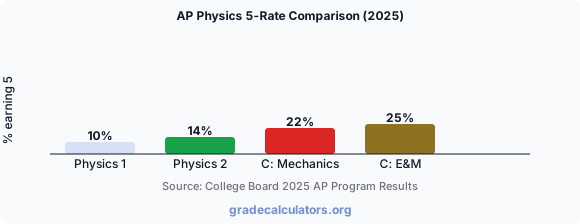
The four AP Physics exams have significantly different pass rates, reflecting differences in course rigor, preparation quality, and test-taker self-selection. The numbers below come from College Board's 2025 AP Program Results.
| AP Score | AP Physics 1 | AP Physics 2 | AP Physics C: Mechanics | AP Physics C: E&M |
|---|---|---|---|---|
| 5 | ~10% | ~14% | ~22% | ~25% |
| 4 | ~18% | ~20% | ~24% | ~24% |
| 3 | ~19% | ~36% | ~27% | ~24% |
| 2 | ~26% | ~18% | ~16% | ~18% |
| 1 | ~27% | ~12% | ~11% | ~9% |
| Pass rate (3+) | ~47% | ~70% | ~73% | ~73% |
| Approx. test-takers | ~170,000 | ~27,000 | ~66,000 | ~33,000 |
AP Physics 1's low pass rate is partly a numbers problem: at 170,000 test-takers, it has by far the largest and most diverse population, including many students who take it without calculus background and without a dedicated physics course in their junior or senior year. The C exams attract a self-selected group who are already in AP Calculus, which explains their higher 5-rates and overall pass rates. AP Physics 2 sits in between, with a smaller cohort (many are students who did well in Physics 1) and more algebra-based depth in second-year topics.
AP Physics Grade Calculator: Which Course Should You Take?
The right AP Physics choice depends on your math background and your intended college major.
If you have not taken or are not currently taking calculus, AP Physics 1 or AP Physics 2 are your options. AP Physics 1 is the standard first-year algebra-based physics course covering kinematics, forces, energy, and waves. AP Physics 2 covers second-year topics including thermodynamics, basic electricity and magnetism, optics, and modern physics. Most schools that offer only one algebra-based AP Physics course offer Physics 1.
If you are in AP Calculus AB or AP Calculus BC, AP Physics C: Mechanics is the natural fit. The exam covers kinematics, Newton's laws, work and energy, rotation, oscillations, and gravity using derivatives and integrals throughout. Students aiming for engineering, physics, or math-intensive STEM programs at selective universities generally get more admissions and credit value from AP Physics C: Mechanics than from AP Physics 1 or 2. A second calculus-based year can add AP Physics C: E&M, which covers electrostatics, conductors, capacitors, circuits, magnetic fields, and electromagnetic induction.
For pre-med students on a life sciences track, AP Physics 1 or AP Physics C: Mechanics both satisfy medical school physics prerequisites, and either works. Some MCAT prep programs actually prefer AP Physics 1 content because the MCAT physics section tests algebra-based reasoning, not calculus. Engineering programs at schools like MIT, Caltech, Stanford, and most Big Ten universities expect AP Physics C: Mechanics with a 4 or 5 for meaningful credit or placement.
AP Physics C: Mechanics Score Calculator and College Credit
AP Physics C: Mechanics is one of the most credit-efficient AP exams for engineers and physical scientists. A 4 or 5 typically places out of the first semester of introductory calculus-based physics at most universities. For specific policies: MIT requires a 5 for 12 units of Physics I credit. Stanford awards 11 units for a 5. Ohio State awards 4 credit hours per exam for a 4 or 5. UC Berkeley awards 4 units for a 4 or 5 on Mechanics. Check current policies at your target schools directly; the College Board AP credit policy search is the fastest starting point.
For detailed Mechanics and E&M scoring with per-FRQ inputs, backward solver, and per-exam SVG score bands, use the dedicated AP Physics C score calculator.
AP Physics 1 Score Cutoffs and How to Reach Each Band
On AP Physics 1, a score of 3 requires a composite of roughly 32 out of 80 (40%). A 4 requires roughly 43 (54%). A 5 requires roughly 56 (70%). The relatively high threshold for a 5 (70% composite) reflects that scoring well on AP Physics 1 demands precision across both multiple-choice and free-response, even though the exam is algebra-based.
FRQ 2 (Translation Between Representations) carries 12 of the 40 FRQ raw points on the current exam format, making it the highest-value free-response question. Students who practice converting between graphs, diagrams, equations, and verbal descriptions of the same physical situation consistently show the strongest FRQ section performance. For dedicated AP Physics 1 scoring, use the AP Physics 1 score calculator.
AP Physics E&M Score Calculator and Why It Has a Higher 5-Rate
AP Physics C: E&M's 25% five-rate is the highest of the four AP Physics exams, but this figure can mislead. The roughly 33,000 students who take E&M are, by definition, students who already passed AP Calculus and typically performed well on AP Physics C: Mechanics. They are a deeply self-selected group. The E&M exam itself is arguably the hardest of the four because it demands vector calculus operations (line integrals in Faraday's Law, surface integrals in Gauss's Law, and curl/divergence concepts from multivariable calculus) that go beyond standard AP Calculus AB content.
Students planning to take E&M should ensure they are comfortable with AP Calculus BC material or equivalent, particularly with parametric and polar coordinates, series, and integration techniques. For the dedicated E&M calculator with per-FRQ inputs, visit the AP Physics C score calculator.
AP Physics College Credit: What Score Do You Need?
| Exam | Score 5 | Score 4 | Score 3 |
|---|---|---|---|
| AP Physics 1 | Credit at most schools; placement into calculus-based physics at some | Credit at most schools | Credit at some schools; no placement at selective programs |
| AP Physics 2 | Credit at most schools; second-semester placement at some | Credit at most schools | Credit at a smaller number of schools |
| AP Physics C: Mechanics | First-semester calculus-based physics credit at nearly all universities | Credit at most universities; some require 5 for placement | Credit at some schools; rarely earns placement into upper-level coursework |
| AP Physics C: E&M | Second-semester calculus-based physics credit at nearly all universities | Credit at most universities | Credit at some; selective engineering schools typically require 4 or 5 |
Always verify policies directly with each school's registrar. Credit policies change, and the College Board's AP credit policy search tool at apstudents.collegeboard.org lets you search by institution. Note that earning AP credit does not automatically enroll you in a higher course; you typically need to formally request credit through your registrar and may need to complete a placement assessment at some engineering programs regardless of AP score.
If you're preparing for multiple AP sciences in the same exam season, the AP Chemistry score calculator and AP score calculator hub cover the full AP subject lineup with the same forward and backward solver approach used here.
This calculator estimates AP Physics exam scores using published College Board scoring methodology and calibrated cutoffs from the 2025 administration. Score cutoffs shift by a few points each year based on overall exam difficulty; your official score may differ by one band. For the current scoring documentation, see the College Board AP Score Scale Table and the AP Physics course pages on AP Central. Official scores release in early July via the College Board AP Score Reports portal. Last verified: May 2026.