Calculate your Hungarian university GPA
Hungarian 1 to 5 scale (default). Enter each course with ECTS credits and the integer grade earned. 5 = Jeles (Excellent), 4 = Jo (Good), 3 = Kozepes (Satisfactory), 2 = Elegseges (Pass), 1 = Elegtelen (Fail). Weighted by ECTS credits (Sulyozott Tanulmanyi Atlag).
Most Hungarian universities apply the Ministry band (85-100 = 5, 71-84 = 4, 61-70 = 3, 51-60 = 2, 0-50 = 1). Debrecen Faculty of Engineering and several Hungarian medical schools use strict 10-point bands. Check your course syllabus before choosing.
| Course | ECTS | Grade | Remove |
|---|---|---|---|
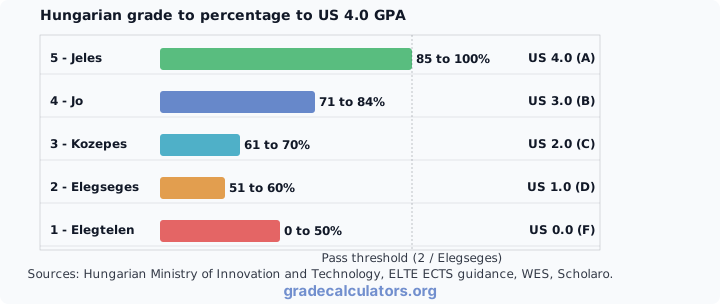
Hungarian grading scale reference (1 to 5, percentage bands, US 4.0)
| Hungarian Grade | Name | English | Percentage (Ministry) | US 4.0 GPA | ECTS |
|---|---|---|---|---|---|
| 5 | Jeles | Excellent | 85 to 100 | 4.0 | A / B |
| 4 | Jo | Good | 71 to 84 | 3.0 | C |
| 3 | Kozepes | Satisfactory | 61 to 70 | 2.0 | D |
| 2 | Elegseges | Sufficient (Pass) | 51 to 60 | 1.0 | E |
| 1 | Elegtelen | Insufficient (Fail) | 0 to 50 | 0.0 | F / FX |
Canonical Hungarian university grading scale per the Hungarian Ministry of Innovation and Technology (Innovacios es Technologiai Miniszterium) and the European Credit Transfer System (ECTS) alignment used at every Bologna Process Hungarian university. Some institutions (Debrecen Faculty of Engineering, several Hungarian medical schools) apply stricter 10-point percentage bands (90-100 = 5, 80-89 = 4, etc.). The diploma classification thresholds (Kitunteteses 4.50+, Dicseretes 4.00+) are nationally standardised.
How the Hungary GPA Calculator Works (Sulyozott Tanulmanyi Atlag, US 4.0 GPA)
The Hungary GPA calculator above runs two modes because Hungarian universities record grades in two ways. University mode (the default) handles the integer 1 to 5 scale that appears on every official transcript, leckekonyv (paper index book), and Neptun electronic record at Hungarian universities. Percentage mode handles raw exam percentages, useful when your lecturer publishes the per-question mark sheet before applying the 1 to 5 band conversion, or when you are mapping an internal university percentage from a Hungarian medical school or Stipendium Hungaricum partner programme to the official Hungarian grade.
In both modes the math follows the same credit-weighted formula. Each grade on the 1 to 5 scale is multiplied by the course ECTS credit value, the products are summed across all courses in the period, and the total is divided by the sum of ECTS credits. This produces the Sulyozott Tanulmanyi Atlag (the weighted academic average), the headline figure on every Hungarian semester transcript. The result panel shows the average on the native 1 to 5 scale, the matching Hungarian descriptor (Jeles, Jo, Kozepes, Elegseges, Elegtelen), the diploma classification (Kitunteteses Summa Cum Laude at 4.50 and above, Dicseretes Cum Laude at 4.00 and above), the US 4.0 GPA equivalent for graduate school applications, and the UK degree classification (First, 2:1, 2:2, Third) for UK university transfer. This is your Hungarian gpa calculator, your gpa calculator hungary college reference, your university gpa calculator workflow, and a 5 scale gpa calculator pattern that handles the Hungarian use case end to end.
This Hungarian GPA calculator runs the same Sulyozott Tanulmanyi Atlag (weighted grade point average) workflow used by every Hungarian university, converted to its US GPA equivalent. A 4.5 GPA on the Hungarian 1 to 5 scale corresponds to roughly a 3.5 US GPA, eligible for Kitunteteses (Summa Cum Laude) diploma classification on the Hungarian degree certificate. A 4.0 average converts to a 3.0 US GPA and qualifies for Dicseretes (Cum Laude). For students at the University of Debrecen, the calculate gpa university of debrecen pattern uses the Standard preset by default at most faculties, although the Faculty of Engineering and several medical programmes apply the stricter 10-point percentage bands available in Percentage mode.
The Hungarian 1 to 5 Grading Scale at Universities (Jeles, Jo, Kozepes, Elegseges, Elegtelen)
Hungarian universities use a five-point integer scale across every faculty, from medicine and engineering to liberal arts and music. The grades and their official Hungarian names appear on the leckekonyv (paper index book) at older universities and on the Neptun electronic study system used by every state university in Hungary. The five grade values:
- 5 (Jeles, Excellent): the highest grade, awarded for comprehensive mastery of the subject material with minimal errors. Equivalent to a US A and a 4.0 GPA. Some institutions also use the rare 5* notation for outstanding performance, although the official transcript records only the integer 5.
- 4 (Jo, Good): a solid above-average mark awarded for confident application of the subject material with minor gaps. Equivalent to a US B and a 3.0 GPA.
- 3 (Kozepes, Satisfactory): a middle-band pass awarded when the student has covered the essential material with notable shortcomings. Equivalent to a US C and a 2.0 GPA.
- 2 (Elegseges, Sufficient or Pass): the minimum passing grade. The student meets the basic requirement but with clear weaknesses. Equivalent to a US D and a 1.0 GPA.
- 1 (Elegtelen, Insufficient or Fail): the only failing grade in the Hungarian system. The student must retake the exam in the same exam period or repeat the course in a later semester. Equivalent to a US F and a 0.0 GPA. There is no credit awarded for an Elegtelen.
There are no plus or minus variants on the official Hungarian transcript. Some lecturers use internal notation like 4- or 3+ during the term for draft marks, and a few institutions allow informal half-grades (4.5) during seminar assessment, but the final grade recorded on the leckekonyv and the Neptun system is always an integer from 1 to 5. The Hungarian Ministry of Innovation and Technology (Innovacios es Technologiai Miniszterium) maintains this convention as the national standard across all accredited Hungarian higher education institutions.
How GPA Is Calculated in Hungarian Universities
Every Hungarian university uses the same weighted-average formula to compute the Sulyozott Tanulmanyi Atlag. The math is identical across BME, ELTE, Debrecen, Pecs, Szeged, Corvinus, and Semmelweis; only the per-faculty rules around grade replacement and the credit-completion penalty differ.
- Grade = the integer grade from 1 to 5 on the Hungarian scale (5 Jeles, 4 Jo, 3 Kozepes, 2 Elegseges, 1 Elegtelen)
- ECTS Credits = the credit value the course carries (typically 3 to 6 ECTS for a single course; a major exam may carry 9 to 12 ECTS)
- Sum = total across every course in the period (one semester for the semester atlag, all completed semesters for the cumulative diploma atlag)
Two implementation details specific to Hungarian universities matter for accuracy. First, grade 1 (Elegtelen) does not contribute to the average until the course is passed on retake; the original failed mark is replaced by the new grade in the Neptun system once the retake is recorded. Some universities (ELTE, Corvinus) keep the failed attempt on the audit transcript but use only the latest passing grade for the Sulyozott Tanulmanyi Atlag. Second, the Hungarian ECTS credit weighting follows the European convention exactly: 60 ECTS per academic year, 30 ECTS per semester, with 1 ECTS equal to roughly 25 to 30 hours of student work including lectures, study, and exam preparation.
Sulyozott Tanulmanyi Atlag vs. Korrigalt Kreditindex (Corrected Credit Index)
Hungarian universities track two related average metrics on the official semester report. The first is the Sulyozott Tanulmanyi Atlag (the figure the calculator above produces), which is the credit-weighted average of all completed courses in the period. The second is the Korrigalt Kreditindex (KKI, the corrected credit index), which is the more rigorous figure used for state scholarship eligibility, residence hall allocation, and tuition-free placement decisions.
- Sum(Grade x Credits) = the same weighted sum as the Sulyozott Tanulmanyi Atlag numerator
- 30 = the expected ECTS credit load per semester under the Bologna Process at Hungarian universities
- Credits Completed / Credits Attempted = the completion ratio penalty (a student who failed a course earning only 24 of 30 attempted credits has a ratio of 0.8)
The diploma classification at graduation uses the Sulyozott Tanulmanyi Atlag, not the KKI. The KKI is used during the degree for semester-by-semester benchmarks: in many Hungarian state scholarships, a KKI of 4.0 or above qualifies for state-funded continued enrolment, a KKI between 3.5 and 4.0 triggers a partial subsidy, and a KKI below 3.0 may result in fee-paying status or loss of state support. Some universities also apply a Sulyozott Tanulmanyi Atlag minimum of 2.5 for residence hall priority and Erasmus mobility selection. The calculator above produces the Sulyozott Tanulmanyi Atlag, which is the figure most international applicants need for graduate school conversion.
Hungarian Diploma Classifications: Kitunteteses, Dicseretes, Standard
Hungarian universities award one of three diploma classifications at graduation, depending on the cumulative Sulyozott Tanulmanyi Atlag across the full degree programme. The classifications are nationally standardised, although the exact threshold values differ slightly across institutions and faculties.
- Kitunteteses Diploma (Summa Cum Laude, Top Honours): awarded when the cumulative Sulyozott Tanulmanyi Atlag is 4.50 or above on the 1 to 5 scale. Some universities (Corvinus, Semmelweis, ELTE Faculty of Law) apply a stricter 4.51 threshold and may require a minimum grade in the thesis defence. Kitunteteses translates literally as "with distinction" and is the equivalent of Summa Cum Laude in the US system or First Class with Distinction in the UK system.
- Dicseretes Diploma (Cum Laude, Distinction): awarded when the cumulative Sulyozott Tanulmanyi Atlag is between 4.00 and 4.49. Dicseretes translates as "with praise" and is the equivalent of Cum Laude in the US system or Upper Second-Class Honours (2:1) in the UK system.
- Diploma (Standard): awarded when the cumulative Sulyozott Tanulmanyi Atlag is between 2.00 and 3.99. The diploma is awarded but without a Latin honours designation. This is the standard outcome for most Hungarian graduates and is equivalent to a Lower Second-Class (2:2) or Third-Class (Third) UK honours degree, or a US 2.0 to 2.9 GPA.
- Below 2.00 (No Diploma): the degree is not awarded; the student must repeat courses or improve the cumulative average before graduation. A single Elegtelen (1) in any single course must be cleared on retake; multiple Elegtelen results trigger academic probation and possible dismissal.
The diploma classification appears on the official degree certificate (oklevelet) and on the European Diploma Supplement issued by every Hungarian university under the Bologna Process. Stipendium Hungaricum scholarship students (the Hungarian government-funded international student programme) are graded on the same 1 to 5 scale as domestic students and are eligible for Kitunteteses and Dicseretes classifications on the same thresholds as domestic graduates.
Convert Hungarian Grades to a US 4.0 GPA for Graduate School
Hungarian university graduates applying to US graduate programmes need their Sulyozott Tanulmanyi Atlag expressed on the US 4.0 scale. The mapping below is what most US graduate programmes, credential evaluators (WES, ECE, Scholaro, SpanTran), and admissions offices apply when reading Hungarian transcripts. The 1 to 5 Hungarian scale maps proportionally because the passing band starts at 2 (rather than 0); subtract 1 from the Hungarian grade to get the US grade-point equivalent.
| Hungarian grade | Hungarian name | English | US 4.0 GPA | US letter | UK class |
|---|---|---|---|---|---|
| 5 | Jeles | Excellent | 4.0 | A | First Class |
| 4 | Jo | Good | 3.0 | B | Upper Second (2:1) |
| 3 | Kozepes | Satisfactory | 2.0 | C | Lower Second (2:2) |
| 2 | Elegseges | Sufficient (Pass) | 1.0 | D | Third Class / Pass |
| 1 | Elegtelen | Insufficient (Fail) | 0.0 | F | Fail |
For formal US graduate school applications, World Education Services (WES) generates an authoritative course-by-course US GPA from Hungarian transcripts (cost roughly USD 200 to 250 in 2026, turnaround 7 to 14 business days). Educational Credential Evaluators (ECE) and Scholaro are common alternatives accepted at most US graduate programmes. The Hungarian Magyar Ekvivalencia es Informacios Kozpont (ENIC-NARIC Hungary) issues the official Diploma Supplement at each Hungarian university, which most European universities accept directly under the Bologna mutual recognition framework. The calculator above is for planning purposes; for binding applications a WES report or a Diploma Supplement from your Hungarian university is the authoritative source.
Hungarian Percentage Bands: Standard Ministry vs. Strict Debrecen
Hungarian universities apply two main percentage-to-grade band conventions. The Standard Ministry preset follows the canonical Hungarian Ministry of Innovation and Technology guidance and applies at most universities including BME (Budapest University of Technology and Economics), ELTE (Eotvos Lorand University), Corvinus, and the University of Szeged. The Strict Debrecen preset uses 10-point band cutoffs and applies at the University of Debrecen Faculty of Engineering, Semmelweis University medical programmes, and several other Hungarian medical schools.
| Hungarian grade | Standard Ministry (BME, ELTE, Corvinus) | Strict Debrecen (Engineering, Medical) |
|---|---|---|
| 5 (Jeles) | 85 to 100% | 90 to 100% |
| 4 (Jo) | 71 to 84% | 80 to 89% |
| 3 (Kozepes) | 61 to 70% | 70 to 79% |
| 2 (Elegseges) | 51 to 60% | 60 to 69% |
| 1 (Elegtelen) | 0 to 50% | 0 to 59% |
The same raw exam percentage produces a different 1 to 5 grade depending on the institutional preset. A student scoring 88 percent on a final exam earns a 5 Jeles at BME under the Standard preset, but only a 4 Jo at the University of Debrecen Faculty of Engineering under the Strict preset. Before entering a percentage in the Percentage mode of the calculator above, confirm which preset your faculty uses; the course syllabus, the lecturer (oktato), or the registrar (tanulmanyi osztaly) can clarify. The Stipendium Hungaricum scholarship handbook also documents the percentage-to-grade rule for each partner Hungarian university.
What Counts as a Good GPA at Hungarian Universities
On the Hungarian 1 to 5 scale, academic standing thresholds follow a consistent pattern across most universities. The key benchmarks to know:
- Kitunteteses Diploma (Top Honours): 4.50 and above. Competitive for top US, UK, and European graduate schools; for the Stipendium Hungaricum graduate-level continuation; and for the European Erasmus Mundus and DAAD scholarship programmes. US 4.0 equivalent of roughly 3.5 and above.
- Dicseretes Diploma (Distinction): 4.00 to 4.49. Meets entry thresholds at most international Masters programmes; competitive for most Erasmus mobility selection and many fellowship programmes. US 4.0 equivalent of roughly 3.0 to 3.5.
- Strong Pass: 3.50 to 3.99. Sufficient for most graduate-school applications; the Hungarian Tempus Public Foundation (which administers Stipendium Hungaricum) typically requires this minimum from non-EU partner countries. US 4.0 equivalent of roughly 2.5 to 3.0.
- Standard Pass: 2.00 to 3.49. Meets the graduation minimum and qualifies for the standard diploma. May be below the threshold for many competitive international programmes, although strong test scores (GRE, GMAT, TOEFL) can offset. US 4.0 equivalent of roughly 1.0 to 2.5.
- Below 2.00 (Sulyozott Tanulmanyi Atlag): degree not awarded. The student must repeat courses or improve the cumulative average. A single Elegtelen (1) in a course must be cleared on retake; persistent failing marks trigger academic dismissal at most Hungarian universities.
For job placements within Hungary, most large employers in finance (OTP Bank, K and H Bank), tech (Ericsson, Nokia Skylight, BlackRock Budapest), and consulting (McKinsey, BCG, Bain) prefer a Sulyozott Tanulmanyi Atlag of 4.0 or above paired with strong English-language proficiency. Hungarian medical school graduates from Semmelweis, Debrecen, Pecs, and Szeged compete internationally on residency placements where the 4.5+ Kitunteteses band is highly favoured for top US Match programmes and for German Approbation routes.
Hungarian University GPA Calculator Directory
The Hungarian universities below all use the 1 to 5 grading scale with institution-specific percentage-band conventions and Kitunteteses or Dicseretes threshold variations. Per-university dedicated pages with the exact faculty-specific rules are coming soon. In the meantime, use the hub calculator above with the appropriate percentage preset (Standard for BME, ELTE, Corvinus, Szeged; Strict Debrecen for University of Debrecen Engineering and medical programmes).
Most other Hungarian universities (University of Miskolc, Obuda University, Pannon University in Veszprem, University of Sopron, Eszterhazy Karoly Catholic University) follow the same 1 to 5 grading scale with the Standard Ministry percentage preset. The calculator above handles the common case; for institution-specific accuracy on Kitunteteses thresholds and KKI calculations, cross-check with the tanulmanyi osztaly (study office) at your university before any binding application.
The Stipendium Hungaricum Programme and International Student GPA
Stipendium Hungaricum is the Hungarian government's flagship scholarship programme for international students, administered by the Tempus Public Foundation (Tempus Kozalapitvany). The programme provides full tuition and a monthly stipend at every Hungarian state university across more than 70 partner countries. Scholarship recipients are enrolled in standard degree programmes and graded on the same 1 to 5 Hungarian scale as domestic Hungarian students, with the same Sulyozott Tanulmanyi Atlag and Korrigalt Kreditindex metrics applied to academic standing decisions.
Admission selection for Stipendium Hungaricum is competitive: most partner countries set the academic threshold at the top 10 to 20 percent of secondary or undergraduate cohorts (in the home country's grading system) plus a strong motivation letter and language proficiency proof. Once enrolled, the Hungarian university applies the local 1 to 5 scale, with the same diploma thresholds (Kitunteteses at 4.50, Dicseretes at 4.00) available to international students. The Hungarian language proficiency requirement varies by programme: most English-language Masters at BME, ELTE, Corvinus, and Debrecen accept TOEFL or IELTS without Hungarian language exam; medical programmes at Semmelweis, Debrecen, Pecs, and Szeged are taught in English with optional clinical-rotation Hungarian language support.
This Hungary GPA calculator estimates the Sulyozott Tanulmanyi Atlag (weighted academic average) on the Hungarian 1 to 5 scale, with the US 4.0 GPA and UK degree classification equivalents, using the credit-weighted average formula documented above. Hungarian universities apply institution-specific rules for grade replacement on retake, the Korrigalt Kreditindex penalty for incomplete credits, thesis-defence bonus consideration, and diploma threshold cutoffs (Kitunteteses, Dicseretes); always verify against your programme regulations (tanulmanyi szabalyzat) and your study office (tanulmanyi osztaly). For US graduate school applications, see the US GPA calculator for the 4.0 scale conversion and consult World Education Services (WES) for the canonical credential evaluation report. Last verified: 2026-05-25.