| Course | Credit hrs | Grade | |
|---|---|---|---|
HEC Pakistan letter grade and percentage reference
| Letter | Marks % | GPA (4.0) | Standing |
|---|---|---|---|
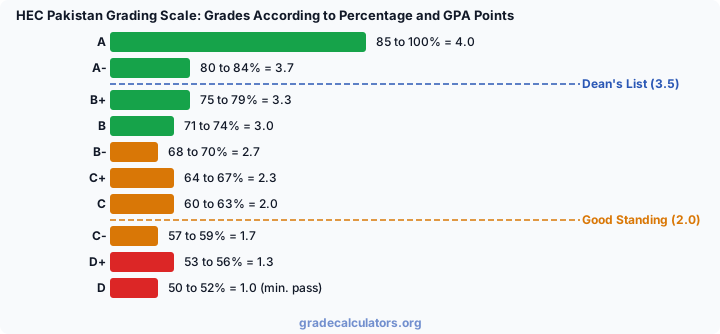
| A | 85 to 100 | 4.0 | Dean's List eligible |
| A- | 80 to 84 | 3.7 | Dean's List eligible |
| B+ | 75 to 79 | 3.3 | Good Standing |
| B | 71 to 74 | 3.0 | Good Standing |
| B- | 68 to 70 | 2.7 | Good Standing |
| C+ | 64 to 67 | 2.3 | Good Standing |
| C | 60 to 63 | 2.0 | Good Standing |
| C- | 57 to 59 | 1.7 | Good Standing |
| D+ | 53 to 56 | 1.3 | Good Standing |
| D | 50 to 52 | 1.0 | Good Standing (minimum pass) |
| F | Below 50 | 0.0 | Fail, no credit |
Source: HEC Pakistan grading framework. Good Academic Standing requires a cumulative GPA of 2.0 or above. Dean's List threshold is 3.5 at most HEC-regulated universities. Individual universities may shift the A- boundary by 1 to 2 percentage points; verify with your registrar. The HEC percentage equivalent uses the linear formula: Percentage = (GPA / 4.0) x 100.
What GPA Stands For in Pakistani University Education
GPA stands for Grade Point Average. In Pakistani higher education, GPA is the credit-weighted average of the grade points earned across your courses. The Higher Education Commission (HEC) Pakistan standardized university grading on the 4.0 scale for all HEC-regulated institutions, so the GPA full form and its calculation are consistent across public and private universities in the country.
Pakistani university transcripts most commonly show a CGPA (Cumulative Grade Point Average) rather than a simple GPA. CGPA covers every semester on your transcript; a per-semester GPA (sometimes labeled SGPA or Semester GPA) covers only the current term. The GPA meaning in Urdu-medium universities is the same: it is the arithmetic average of grade points, each weighted by the credit hours of the course. The HEC framework assigns numeric grade points to each letter grade, and the GPA stands for the weighted sum divided by total credits.
This GPA calculator for Pakistan handles both the per-semester calculation (enter only the current semester's courses) and the cumulative CGPA (enter every course from all semesters). It also accepts raw marks instead of letter grades through the Marks mode, covering the common case where students have a result sheet with marks obtained out of total rather than a letter grade already assigned.
How GPA Is Calculated in Pakistan
Every HEC-regulated Pakistani university uses the same weighted-average formula for GPA, regardless of the program or institution. Only the letter-to-points table varies slightly between universities (by 1 to 2 percentage points at the A/A- boundary), but the formula itself is universal:
- Grade Points = numeric value assigned to the letter grade on the HEC 4.0 scale (A = 4.0; F = 0.0)
- Credit Hours = the credit hours the course carries on your transcript (typically 3 for theory, 1 for lab)
- Sum = totalled across every course in the calculation period (one semester for semester GPA; all semesters for CGPA)
Two details specific to Pakistani universities matter for accuracy. First, credit-hour weighting: a 3-credit theory course influences the GPA three times as much as a 1-credit lab course. Students who prioritize high marks in high-credit courses see larger CGPA improvements than students who focus on low-credit electives. Second, course-retake policy: HEC guidelines generally allow the higher attempt to replace the earlier one in the CGPA calculation, but individual universities apply the policy differently. Check your registrar's handbook before entering retaken courses; the calculator above lets you simply omit the lower attempt if your university uses the replacement rule.
HEC Pakistan Grading Scale: Grades According to Percentage
The HEC Pakistan grading scale defines grades according to percentage ranges and assigns a numeric grade point to each letter. The table below is the standard used at most HEC-regulated universities; the Marks mode in the calculator above applies the same percentage bands automatically when you enter marks obtained and total marks per course.
How to Find GPA from Marks in Pakistan
To find GPA from marks in Pakistan, divide each course's marks obtained by the total marks to get a percentage, then look up the HEC letter grade and grade points for that percentage range. A student who scored 156 out of 200 has earned 78 percent, which falls in the B+ band (75 to 79 percent) and earns 3.3 grade points. Multiply those 3.3 points by the course's credit hours and carry the product into the GPA formula.
The Marks input mode in the calculator above automates this entire process. Switch to the Marks tab, enter the marks obtained and the total marks for each course alongside the credit hours, and the calculator resolves each course's percentage, reads the HEC band, assigns grade points, and computes the weighted CGPA live. This is the "how to calculate GPA from marks obtained" workflow used by students at UAF, UOL, UCP, KU, and other universities that issue results as marks out of a total rather than pre-assigned letter grades.
What Is a Good GPA at Pakistani Universities?
On the HEC 4.0 scale, academic standing thresholds at most Pakistani universities follow a consistent pattern anchored by HEC guidelines:
- Dean's List / Chancellor's List: 3.5 or above. Most HEC universities publish a Dean's List for each semester; the threshold is 3.5 cumulative GPA at COMSATS, UMT, Bahria, FAST-NUCES, and most public-sector universities. LUMS and NUST may set a higher threshold for their honors-track programs.
- Merit scholarship eligibility: typically 3.0 to 3.5 or above. HEC need-cum-merit scholarships and university-specific merit awards usually require a minimum CGPA of 3.0; competitive external scholarships (DAAD, Fulbright, Commonwealth) often require 3.3 or above from a Pakistani university.
- Good Academic Standing: 2.0 or above. Students with a cumulative GPA of 2.0 or above are in Good Academic Standing at virtually all HEC-regulated universities. Falling below 2.0 typically triggers academic probation rules.
- Academic probation: below 2.0. Most universities give students one to two semesters to bring a CGPA below 2.0 back to the minimum; failing to do so can result in suspension or dismissal under HEC academic regulations.
D Grade Meaning in Urdu and Academic Probation Threshold
D grade meaning in Urdu (ڈی گریڈ) indicates a near-failing performance: 50 to 52 percent on the HEC scale earns a D (1.0 grade points) and 53 to 56 percent earns a D+ (1.3 grade points). Both grades count toward graduation credit but contribute little to the cumulative GPA. Accumulating multiple D grades can push the CGPA below the 2.0 Good Academic Standing threshold, triggering academic probation. Students in this situation should use the calculator above to model how an improved semester GPA would raise their cumulative standing.
Converting Pakistani CGPA for US Graduate School Applications
When applying to US universities, Pakistani students typically need to present their CGPA on the US 4.0 scale or commission a formal credential evaluation. The HEC Pakistan 4.0 scale is already a 4.0 scale, so the numeric CGPA transfers directly: a 3.5 at NUST is a 3.5 on the US 4.0 scale without conversion. However, the percentage-to-letter-grade cutoffs differ between Pakistan and the US (a Pakistani A starts at 85 percent, while a US A often starts at 90 or 93 percent), so the same percentage performance produces a lower GPA in Pakistan than in the US.
US graduate programs generally accept the Pakistani CGPA directly on the 4.0 scale. World Education Services (WES) is the most widely accepted credential evaluator in the US; WES produces a course-by-course GPA report from Pakistani transcripts using the HEC scale. Scholaro and ECE (Educational Credential Evaluators) are common alternatives. The GPA calculator above is a planning tool; for actual applications, a WES or equivalent evaluation report is the authoritative source.
Relative Grading at LUMS, NUST, and IBA
A small number of elite Pakistani universities use relative grading (also called curve grading or bell-curve grading) in selected courses or programs. Under relative grading, final letter grades are assigned based on the distribution of exam scores across the class rather than a fixed percentage cutoff. LUMS applies relative grading in most undergraduate courses; NUST and IBA Karachi use it in specific engineering and business courses. Under a relative-grading system, an A grade may require a lower absolute percentage than the HEC standard if the class median was low, or a higher absolute percentage if performance was strong across the board. Students at relative-grading institutions should use the letter grade assigned by the registrar (not the raw percentage) as the input to this GPA calculator; the letter is the GPA-relevant figure that appears on the official transcript.
GPA Calculator Pakistan: University Directory
Each of the 23 Pakistani universities below has a dedicated CGPA calculator page covering institution-specific grading policies, credit-hour structures, GPA thresholds, academic standing rules, and honors criteria. Select your university to open its tailored calculator; all pages use the HEC 4.0 scale with university-verified policy data.
USKT GPA Calculator, CUST, IBA Grading, and University Scale Variations
IBA Karachi (Institute of Business Administration) uses the same 4.0 scale for GPA reporting but applies relative grading in most courses, so the iba grading system produces letter grades via class-rank distribution rather than fixed percentage bands. The GPA points per letter (A = 4.0, B+ = 3.3, B = 3.0, and so on) are identical to the HEC table above; the difference is how the letter is determined. NUST uses the HEC 4.0 scale with fixed percentage bands similar to the table above, with a minimum passing mark of 50 percent. USKT (University of Science and Technology Khyber Pakhtunkhwa), CUST (Capital University of Science and Technology), GIKI (Ghulam Ishaq Khan Institute), and PUCIT (Punjab University College of Information Technology) all follow the HEC 4.0 scale; some shift the A cutoff to 90 percent rather than 85 percent, and a few add a separate A+ (4.0) and A (3.9) split at the top band. The grading list for your specific university is available on the registrar's page; the calculator above uses the most common HEC-standard cutoffs.
GPA Full Form and GPA Meaning in Pakistani Education
GPA Meaning in Urdu: Grade Point Average (جی پی اے)
GPA full form is Grade Point Average. In Pakistani higher education, the two most common uses are GPA (for a single semester's average, used interchangeably with SGPA at some universities) and CGPA (Cumulative Grade Point Average, covering all semesters). The total GPA in university contexts refers to the CGPA: the career-average figure that universities report on official transcripts and that graduate programs, employers, and scholarship committees use for assessment.
The American GPA system that Pakistan follows arrived with the HEC's adoption of semester-based credit-hour programs in the 1990s and 2000s, replacing the older annual percentage-based system that legacy universities still use for O-Level and matric results. Most modern Pakistani degree programs now report CGPA on the 4.0 scale; older-format transcripts from universities that still issue percentages can be entered into the Marks mode of the calculator above to obtain an equivalent GPA estimate.
Accuracy and Source Note
The grading scale on this page follows the standard published by the Higher Education Commission (HEC) Pakistan and is consistent with the grading frameworks used at COMSATS, UAF, UMT, Bahria, FAST-NUCES, NUST, and most HEC-regulated public and private universities as of 2026. Individual universities may shift the A or A- percentage boundary by 1 to 2 percentage points or use relative grading in selected courses. Always verify your specific institution's grading scale in the academic regulations or registrar handbook before relying on this calculator for official purposes (scholarship applications, graduate school applications, or academic-standing disputes). The GPA and CGPA values produced by this calculator are estimates intended for planning; official values are those on your transcript signed by the controller of examinations.