| Subject | Credit hrs | Grade | |
|---|---|---|---|
Nepal letter grade and percentage reference (NEB and university 4.0)
| Letter (NEB) | Marks % | GPA (4.0) | Standing |
|---|---|---|---|
| A+ | 90 to 100 | 4.0 | Outstanding |
| A | 80 to 89 | 3.6 | Excellent |
| B+ | 70 to 79 | 3.2 | Very good |
| B | 60 to 69 | 2.8 | Good |
| C+ | 50 to 59 | 2.4 | Satisfactory |
| C | 40 to 49 | 2.0 | Acceptable |
| D | 35 to 39 | 1.6 | Partially acceptable (minimum pass) |
| NG | Below 35 | 0.0 | Not graded; improvement exam required |
Source: National Examination Board (NEB) Nepal, Letter Grading System Implementation Directive 2076 BS. University 4.0 scale: A = 4.0, A- = 3.7, B+ = 3.3, B = 3.0, B- = 2.7, C+ = 2.3, C = 2.0, C- = 1.7, D+ = 1.3, D = 1.0, F = 0.0 (Tribhuvan University Semester System Operational Guideline 2070 BS; Kathmandu University absolute grading framework). Percentage equivalent uses the NEB and TU linear rule: Percentage = GPA x 25. Pokhara University uses Percentage = GPA x 20.
How to Calculate GPA in Nepal
GPA stands for Grade Point Average. In Nepal, the same credit-weighted formula applies whether you are calculating a Class 11 or 12 result from NEB, a semester average at Tribhuvan University, or a cumulative figure at Kathmandu University. Multiply each subject's grade points by its credit hours, sum the quality points, and divide by total credits. The Nepal GPA system uses a 4.0 grade point axis at every level; what changes between NEB and university grading is the letter scheme and the percentage bands attached to each letter.
- Grade Points = numeric value assigned to the letter grade (NEB A+ = 4.0; university A = 4.0)
- Credit Hours = credit weight on the subject (typically 1 per NEB subject; 3 per university course)
- Sum = totaled across all subjects in the calculation period
Two details specific to Nepal matter for accuracy. NEB Class 11 and Class 12 subjects each carry 1 credit by default, so the credit-weighted average equals a simple arithmetic average for a standard NEB result. University courses at TU, KU, PU, and PBU carry varying credit hours (3, 4, or 5), so the weighting matters: a high grade in a 4-credit course moves the GPA more than the same grade in a 3-credit course. Second, the percentage-to-letter mapping differs between NEB and the university scale. NEB requires 90 percent for A+; a Nepali university A also requires 90 percent but a university A- starts at 80 percent, giving the university scale an intermediate step that NEB does not have.
Students from India or Pakistan planning to study at Nepali universities may find the calculator on our India GPA calculator or Pakistan GPA calculator pages useful for comparing their home-country CGPA against Nepal's 4.0 axis before applying.
GPA Grading System in Nepal: NEB and University Scales
Nepal operates two parallel GPA grading systems. The NEB (National Examination Board) scale is used for Class 11 and Class 12 (the higher secondary level, often written as plus 2) and historically for SLC and SEE at Class 10. The university 4.0 scale is used at every semester-system Bachelor's and Master's program at Tribhuvan, Kathmandu, Pokhara, Purbanchal, and the newer provincial universities. Each system has its own letter set, percentage bands, and conversion rule.
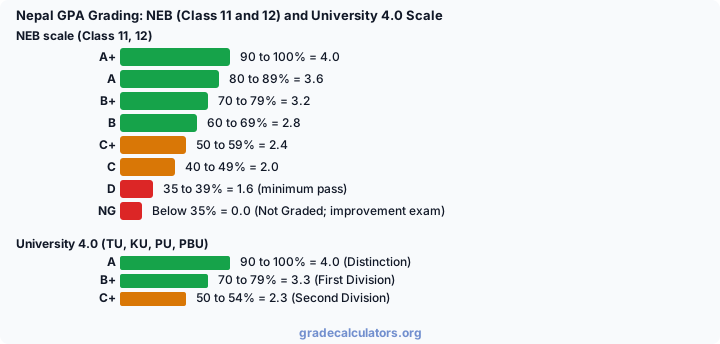
NEB Grading System for Grade 12, Grade 11, and SEE Class 10
The NEB grading system uses 8 letter grades plus an NG marker for below-pass performance. A+ requires 90 percent or above (4.0 grade points); A covers 80 to 89 percent (3.6); B+ covers 70 to 79 (3.2); B covers 60 to 69 (2.8); C+ covers 50 to 59 (2.4); C covers 40 to 49 (2.0); D covers 35 to 39 (1.6); and NG (Not Graded) is anything below 35 percent (0.0). NEB applies the same scale to Class 11, Class 12, and SEE (formerly SLC) Class 10 results.
Theory and practical marks combine into a single subject percentage before the letter is assigned. The typical split is 75 marks theory and 25 marks practical for science subjects; some subjects use a 50/50 split. A student with strong theory but weak practicals can still score B+ overall if the combined percentage clears 70. NEB also has a separate minimum for the theory component in many subjects: a student cannot fail the theory paper alone and still pass the subject, even if the combined percentage exceeds 35.
Nepal University 4.0 Grading System (TU, KU, PU, PBU)
The Nepali university 4.0 grading system uses 11 letter grades: A, A-, B+, B, B-, C+, C, C-, D+, D, F. The grade point values follow the standard US 4.0 convention (A = 4.0, A- = 3.7, B+ = 3.3, B = 3.0, B- = 2.7, C+ = 2.3, C = 2.0, C- = 1.7, D+ = 1.3, D = 1.0, F = 0.0). The percentage bands that map to each letter differ slightly between universities; the most common cutoffs are A at 90 percent and above, B+ at 70 to 79, C+ at 50 to 54, and F below 30 at TU and KU. Pokhara University and Purbanchal University follow similar bands with minor adjustments at the lower end.
Nepal University Grading Systems Compared
The table below shows the grading system, percentage-to-GPA conversion formula, minimum passing CGPA, and division thresholds for the six major Nepali universities. TU is the largest and sets the baseline; KU and PU apply the same 4.0 letter scale with slightly different conversion formulas for percentage equivalents.
| University | Scale | Pct Conversion | Min CGPA | Distinction | First Div |
|---|---|---|---|---|---|
| TU (Tribhuvan) | 4.0 (A to F) | GPA x 25 | 2.0 | 3.7 (A-) | 3.0 (B) |
| KU (Kathmandu) | 4.0 (A to F) | (GPA / 4.0) x 100 | 2.0 | 3.7 (A-) | 3.0 (B) |
| PU (Pokhara) | 4.0 (A to F) | GPA x 20 | 2.0 | 3.6 | 3.0 (B) |
| PBU (Purbanchal) | 4.0 (A to F) | GPA x 25 | 2.0 | 3.6 | 3.2 (B+) |
| NEB (Class 11, 12) | 4.0 (A+ to NG) | GPA x 25 | 1.6 (D) | 3.6 (A) | 3.2 (B+) |
| SEE (Class 10) | 4.0 (A+ to NG) | GPA x 25 | 1.6 (D) | 3.6 (A) | 3.2 (B+) |
The difference in percentage conversion formulas matters when converting a Pokhara University GPA to a percentage for scholarship forms. A 3.0 PU GPA equals 60 percent under the PU formula (3.0 x 20 = 60), while the same 3.0 GPA at TU equals 75 percent (3.0 x 25 = 75). The underlying grade point is identical; only the percentage representation on the form changes. Always specify which university issued the transcript when reporting percentage equivalents.
Grading System for 75 Marks in Nepal
NEB letter cutoffs are expressed in percentages, not absolute marks. A 75-mark paper applies the same percentage bands to the scaled total. A student who earns 60 out of 75 has scored 80 percent (60 divided by 75), which earns an A grade (3.6 grade points) under NEB rules. A student who earns 45 out of 75 has scored 60 percent, which earns a B grade (2.8).
The Percent mode of the calculator above handles this directly: enter the marks obtained and the total marks for each paper, and the calculator does the percentage conversion and the NEB letter lookup. This is especially useful for theory plus practical combinations where the totals differ (theory might be out of 75 and practical out of 25, summed to 100). Enter each as a separate marks pair and let the calculator weight them by credit.
How to Calculate Class 11 and 12 GPA in Nepal
List all subjects from both years (typically 5 subjects per year plus 1 optional, for 10 to 12 total), enter the credit value (1 per NEB subject by default), and select the letter grade from the NEB mark sheet. The calculator produces the overall plus 2 GPA on the 4.0 axis. NEB publishes both an individual Class 11 GPA and an individual Class 12 GPA on the final mark sheet; the overall plus 2 GPA is typically the average of the two.
To reproduce the published overall GPA, enter all 10 to 12 subjects from both years. The credit-weighted formula reduces to the simple average when every subject carries the same credit weight, matching the NEB published figure. For a dedicated Class 11 and 12 GPA tool, the NEB GPA calculator spoke page is in development.
TU Percentage to US GPA Conversion
Nepali university CGPA already sits on the 4.0 scale, so the numeric figure transfers directly when applying to US graduate schools. A 3.5 CGPA at Kathmandu University is a 3.5 on the US 4.0 scale without conversion. NEB Class 12 GPA also sits on the 4.0 scale. For US graduate applications, US universities accept the Nepali GPA directly. World Education Services (WES) is the most widely accepted credential evaluator and produces a course-by-course GPA report from Nepali transcripts.
| TU Percentage | TU Letter | TU GPA (4.0) | US 4.0 Equiv | Standing |
|---|---|---|---|---|
| 90 to 100 | A | 4.0 | 4.0 | Distinction |
| 80 to 89 | A- | 3.7 | 3.7 | Distinction |
| 70 to 79 | B+ | 3.3 | 3.3 | First Division |
| 60 to 69 | B | 3.0 | 3.0 | First Division |
| 55 to 59 | B- | 2.7 | 2.7 | Second Division |
| 50 to 54 | C+ | 2.3 | 2.3 | Second Division |
| 45 to 49 | C | 2.0 | 2.0 | Second Division (minimum) |
| 40 to 44 | C- | 1.7 | 1.7 | Pass |
| 35 to 39 | D+ | 1.3 | 1.3 | Pass (borderline) |
| 30 to 34 | D | 1.0 | 1.0 | Pass (lowest) |
| Below 30 | F | 0.0 | 0.0 | Fail |
Australian and UK universities typically accept Nepali GPA with their own internal conversion. Australian institutions often map a 3.0 Nepali university GPA to a UK 2:2 or Australian Pass equivalent. ECE (Educational Credential Evaluators) and SpanTran are common alternatives to WES for formal US applications. For scholarship applications routed through Japanese MEXT or Commonwealth (UK) programs, the percentage basis is assessed directly rather than through a numeric scale conversion.
Nepal GPA Calculator: University Directory
The six largest Nepali universities below all use the standard 4.0 letter scale for semester-system programs. Tribhuvan is the oldest and largest; Kathmandu and Pokhara dominate private and technical education; Purbanchal, Far-Western, and Mid-Western serve the eastern, far-western, and mid-western regions. Each publishes its own grading directive and minimum-CGPA-to-graduate rule (typically 2.0 across the system).
What 3.20 and 2.80 GPA Mean in Nepal
A GPA of 3.20 in Nepal sits in the NEB B+ band (70 to 79 percent), which means very good performance and qualifies for most undergraduate entrance examinations at Nepali universities. A GPA of 2.80 sits in the NEB B band (60 to 69 percent), which qualifies for general admission but typically falls short of the cutoff for competitive programs like engineering at IOE Pulchowk or medicine at IOM.
These numbers map to the same B+ and B letters on the university 4.0 scale but with different grade point values: a university B+ is 3.3 (not 3.2) and a university B is 3.0 (not 2.8). The 0.1 and 0.2 differences come from the slightly different grade point assignment at the university level; the calculator above handles both conventions automatically when you switch modes.
B+ GPA in Nepal on NEB vs University Scale
On the NEB plus 2 scale, B+ is 3.2 grade points (70 to 79 percent). On the Nepali university 4.0 scale, B+ is 3.3 grade points and represents the same 70 to 79 percent band at TU and KU. The 0.1 difference matters for international graduate school applications: a Nepali B+ from a university transcript reads as 3.3 on the US 4.0 scale, while a Class 12 B+ from NEB reads as 3.2 when WES applies its credential-evaluation rule. The calculator result panel shows both equivalents when you switch between NEB and University mode.
NEB SEE Stream Eligibility and GPA Requirements
SEE (Secondary Education Examination, formerly SLC) results determine which stream a student can enter for Class 11. The stream cutoffs are GPA-based, not just aggregate percentage. Science stream entry requires a minimum 2.0 GPA (C grade range) with at least C+ in both Mathematics and Science on the SEE mark sheet. Management and Humanities streams require a minimum 1.6 GPA (D grade). Vocational stream entry is open to all students who pass (D grade and above in each subject).
Individual subject passes matter separately from overall GPA. A student can have a 3.0 overall GPA but still be barred from Science stream if they earned below C+ in Mathematics. The NG (Not Graded) marker in any subject requires clearing a Grade Improvement Examination before stream selection proceeds. These rules apply to the 2083 BS examination year; NEB periodically revises stream cutoffs by circular, so always verify the current year's directives on the NEB official website before advising students.
Accuracy and Source Note
The NEB scale on this page follows the standard published by the National Examination Board Nepal in the Letter Grading System Implementation Directive 2076 BS. The university 4.0 scale follows the Tribhuvan University Semester System Operational Guideline 2070 BS and the corresponding examination regulations at Kathmandu University and Pokhara University. The University Grants Commission (UGC) Nepal coordinates academic policy across these institutions. Individual universities may shift specific letter cutoffs by 1 to 2 percentage points or apply program-specific rules; always verify your institution's regulations before relying on this calculator for official purposes such as scholarship applications or graduate school submissions. The GPA values this calculator produces are estimates intended for planning; the official values are those printed on your transcript signed by the controller of examinations.
Last verified: May 2026