Enter your rank and class size to see your full standing.
Pick a target top percent (or type a custom value) and your class size.
Class Rank Calculator High School: What the Numbers Mean
The class rank calculator high school workflow takes two inputs and returns five outputs in one screen: percentile, top percent, decile, quintile, and quartile. Percentile measures how many classmates you outrank as a percentage (0 to 100, where 100 is the very top). Top percent inverts that figure so a smaller number is better. A student ranked 47 of 320 sits in the top 14.7 percent, which is the 85.3rd percentile, the 2nd decile, the 1st quintile, and the 1st quartile. Most college applications surface top percent (the rank as a fraction of the class), since that is what auto-admit programs reference directly.
Class Rank Percentage Calculator: Top % vs Percentile vs Decile
The class rank percentage calculator surfaces three related figures that students often confuse. Top percent is rank divided by class size, multiplied by 100. Percentile is 100 minus top percent. Decile splits the class into ten equal bands of 10 percent each, so decile 1 is the top decile (top 10 percent), decile 10 is the bottom. Quintile splits into five 20-percent bands, quartile into four 25-percent bands. Colleges quote the band they care about: Ivy League and equivalent admissions teams talk about top 10 percent (top decile), state flagship auto-admit programs talk about top 6 percent or top 9 percent, NCAA Division I scholarship rules reference top 50 percent. The class rank calculator above returns all bands in one read.
Class Rank Percentile Calculator: When Schools Round the Number
A class rank percentile calculator only matches the official school figure when both sides round the same way. Schools report rank as an integer (you cannot be rank 47.3). Percentile and top percent are continuous values, and counselors typically round to the nearest tenth or whole number. If your school reports "Top 15%" on the secondary school report, that is a rounded bucket: anywhere between top 10.1 percent and top 15.0 percent could land in that band. The calculator above shows two decimal places of precision so you can see exactly where you sit inside the school's rounded bucket.
Auto-Admit Class Rank Thresholds at US Colleges
State-mandated automatic admission programs use class rank directly. The class rank calculator above flags eligibility live as you enter your rank, but the table below shows every threshold currently in use. Always confirm the cutoff for the year you apply, as Texas has tightened the UT Austin threshold from 10 percent down to 7, 6, and as of the 2026 announcement, 5 percent.
| Program | Top % cutoff | What it grants |
|---|---|---|
| UT Austin (Texas HB 588) | Top 6% (Top 5% from fall 2026 entrants) | Auto-admit to the university; major selection not guaranteed |
| Texas A&M auto-admit | Top 10% | Auto-admit to College Station campus |
| Other Texas public flagships | Top 10% | Auto-admit per HB 588 |
| University of California ELC | Top 9% | Guaranteed admission to a UC campus, not a specific one |
| University of Florida | Top 11% (correlated with Bright Futures) | Strong review boost; not a hard auto-admit |
| NCAA Division I academic tier | Top 50% | Eligibility floor for athletic scholarships under standard rules |
GPA and Class Rank: How Schools Order Students
The gpa and class rank calculator math is straightforward once the school sets a ranking basis. Every graduating senior is sorted by cumulative weighted GPA from highest to lowest. Ties break by the school's tie-breaking rule (some schools use unweighted GPA as the tiebreaker, others use number of AP courses, others use senior-year grades). Your position in the sorted list is your rank. The gpa class rank itself does not change unless someone above or below you transfers, retakes a course, or your school recalculates after senior-year grades post.
GPA Ranking: Weighted vs Unweighted Basis
The gpa ranking basis varies by school. About 60 percent of US public high schools that rank use weighted GPA, where AP and honors courses earn 0.5 or 1.0 bonus points on the standard 4.0 scale. The remaining 40 percent use unweighted GPA. A student with five AP courses and a strong but not perfect record can place much higher on the weighted ranking than on the unweighted one. Use the high school GPA calculator to see both numbers side by side, then ask your counselor which basis your school uses to set the official rank.
Ranking GPA: Senior Year Timing
Ranking GPA at most US high schools freezes at the end of first-semester senior year, using a 7-semester cumulative GPA. Colleges receive the snapshot rank with the secondary school report submitted in the fall application window. A few schools recompute at end of senior year and send a revised rank with the final transcript. Whether senior year grades are calculated into valedictorian decisions depends on the same policy: schools using the 7-semester snapshot lock the title at midyear, schools using the 8-semester figure wait until graduation. Check your handbook before assuming.
Class Rank Percentile Formula and Worked Examples
- Rank = your position in the class (1 = top student)
- Class Size = total students in your graduating class
- Percentile = 100 - Top %
- Decile = ceil(Top % / 10), so top decile is decile 1
Class Rank Distribution and Auto-Admit Cutoffs
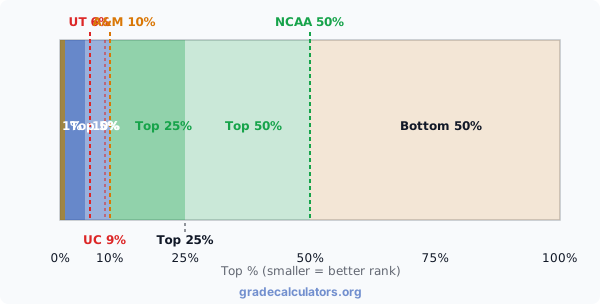
The chart shows why the top 10 percent threshold matters so much in US admissions: it is the cutoff most state flagship auto-admit programs share. Students one or two ranks outside the cutoff still receive full file review, but the auto-admit guarantee is gone. Mode 2 of the calculator above lets you reverse the math: pick a target top percent and your class size, and the calculator returns the minimum rank required to clear that threshold.
AP Class Rankings and Honors Course Strategy
AP class rankings refer to how AP course performance interacts with weighted GPA and class rank. At schools that use weighted GPA as the ranking basis, every A in an AP course earns 5.0 (or 5.0 plus a smaller honors bonus, depending on policy) rather than 4.0. A student who stacks five AP courses and earns As across them gains a structural advantage over a classmate with the same unweighted record. Use the GPA calculator to see the weighted versus unweighted difference, then check whether your school ranks on weighted or unweighted before deciding course load. AP exam scores themselves do not enter the rank calculation, only the AP course grade does, weighted by your school's policy.
Average Valedictorian GPA and Top Rank Benchmarks
The average valedictorian gpa at US public high schools sits between 4.3 and 4.6 weighted, per surveys aggregated by NACAC and the National Honor Society. At schools with deep AP and dual-enrollment offerings, the gpa of valedictorian frequently exceeds 4.6 and can reach 5.0 where the school caps weighted GPA at that level. The salutatorian (rank 2) usually trails the valedictorian by 0.02 to 0.10 weighted points, because top students cluster at the ceiling with identical course loads. Whether your school selects valedictorian by 7-semester or 8-semester cumulative GPA determines whether senior year grades are calculated into valedictorian decisions.
Are Senior Year Grades Calculated Into Valedictorian Selection?
Are senior year grades calculated into valedictorian selection: most US high schools finalize the valedictorian at end of first semester of senior year, using a 7-semester cumulative GPA. A minority of schools wait until end of senior year and use the full 8-semester transcript. A few districts publish a midyear "projected" valedictorian and reconfirm at graduation. Check your school's handbook for the cutoff date. The class rank calculator above accepts whichever rank your school uses for the snapshot, the calculator does not assume a freeze date.
How to Figure Out Your Class Rank Without a Counselor Letter
To figure out your class rank without counselor confirmation, work backward from the school profile. Every accredited US high school publishes a school profile that goes with the secondary school report. The profile usually includes the percentage of seniors above various GPA thresholds (e.g., "12% of seniors above 4.0 weighted GPA in 2024"). Match your GPA to the published distribution to estimate your decile, then convert to top percent with the calculator above. The estimate gets within 5 to 10 percentile points for most classes. For the precise figure, request it through the guidance office, schools must release official rank on request even when they do not publish it openly.
How to Figure Out My Class Rank from a Decile Report
How to figure out my class rank from a decile-only report: multiply the decile band by 10 percent to bracket your top percent, then multiply by class size for the rank window. Decile 1 (top 10 percent) in a class of 400 means rank 1 to 40. Decile 2 means rank 41 to 80. The class rank percentage calculator above (Mode 2) returns the exact rank for the midpoint or boundary of any decile, set target to 5 percent for the middle of decile 1, target to 10 percent for the bottom of decile 1, target to 15 percent for the middle of decile 2, and so on.
State and District Class Rank Policies
Class rank policy varies by state. Texas mandates rank for public high schools because the state's automatic admission law (HB 588) depends on it. California has largely moved away from formal class rank, and most California districts report only deciles or quintiles. Florida districts (Pinellas County and others) maintain class rank for valedictorian and Bright Futures purposes, using cumulative weighted GPA through end of seventh semester. New York, Massachusetts, and Connecticut see the highest no-rank adoption rates among public high schools, with NACAC data showing roughly 50 percent of US high schools no longer publishing exact rank. When in doubt, the school profile attached to your transcript is the authoritative document, request it from your counselor before applying.
How to Calculate Class Rank Based on GPA at a No-Rank School
To calculate class rank based on gpa at a no-rank school, use the school profile's GPA distribution chart. If the profile reports that 15 percent of seniors graduate above 4.0 weighted, a 4.1 GPA places you somewhere inside the top 15 percent. Combine that band with the class size to get a rank window. Some no-rank schools still tell colleges the band privately on the secondary school report, ask your counselor what your school reports. The class rank gpa calculator math is the same either way, the only question is where the rank number originates.
Class Rank Calculator Limitations and Tips
- Match the rank basis your school uses. If your school ranks on weighted GPA, enter the rank produced by the weighted scale. The calculator does not change with the basis, but your input must.
- Use the band from the school profile when exact rank is private. A "Top 10%" band in a class of 320 places you between rank 1 and rank 32, the calculator can estimate within that range.
- Auto-admit cutoffs change. UT Austin moved from Top 10% to Top 8% to Top 7% to Top 6% to (announced) Top 5%. Always verify the cutoff for your application year.
- Cumulative GPA matters more than rank at no-rank schools. Colleges receiving a school profile without rank fall back to GPA, course rigor, and standardized test scores.
- Senior year grades may shift the snapshot rank. Schools using the 8-semester basis recompute after final transcripts post. Check your handbook for the freeze date.
Sources and References
Source: College Board publishes high school ranking practices on its counselor-resource pages. The National Association for College Admission Counseling (NACAC) tracks the percentage of US high schools that publish exact rank versus deciles or no rank. National Center for Education Statistics (NCES) aggregates national grading and ranking policy data. UT Austin Automatic Admission publishes the current Texas Top 6% (and announced Top 5%) policy. University of California ELC documents the Top 9% statewide pathway.
Always verify your official class rank with your school counselor before submitting college applications. Rank policy, basis, and freeze dates vary by school and district.