NEB GPA Calculator: How +2 GPA Is Calculated in Nepal
The National Examinations Board of Nepal uses a credit-weighted average formula to calculate GPA at the +2 level (Grade 11 and Grade 12). Each subject earns a letter grade based on the percentage of marks obtained; that letter maps to a fixed grade point value on the 4.0 scale. The GPA is then the sum of all quality points (grade point multiplied by credit hours) divided by the total credit hours.
In standard NEB Class 11 and Class 12 programs, every subject carries 1 credit hour. This means the credit-weighted average is mathematically identical to a simple arithmetic average of all subject grade points. A student taking 6 subjects simply adds the 6 grade points and divides by 6. The calculator above accepts any credit value, which is useful for vocational or technical +2 programs where some subjects may carry different weights.
- Grade Points = numeric value for the NEB letter grade (A+ = 4.0; NG = 0.0)
- Credit Hours = credit weight of the subject (1 per subject for standard NEB +2)
- Sum = totalled across all subjects in the calculation period
The NEB percentage equivalent uses a linear formula: Percentage = GPA x 25. This gives a quick conversion for situations where a percentage is required rather than a letter or GPA. A GPA of 3.6 (A grade) equals 90%, and a GPA of 2.0 (C grade) equals 50%. This formula is used by NEB, Tribhuvan University, and Kathmandu University on official documents.
Nepal NEB Grading System: A+ to NG Scale
The NEB +2 scale has 10 grade categories. The top four (A+, A, B+, B) cover the 60 to 100 percent range in 10-percentage-point bands. Below 60 percent, the bands narrow: C+ covers 50 to 59%, C covers 40 to 49%, D+ covers 35 to 39%, D covers 30 to 34%, and E covers 20 to 29%. NG (Not Graded) applies to anyone who scores below 20%.
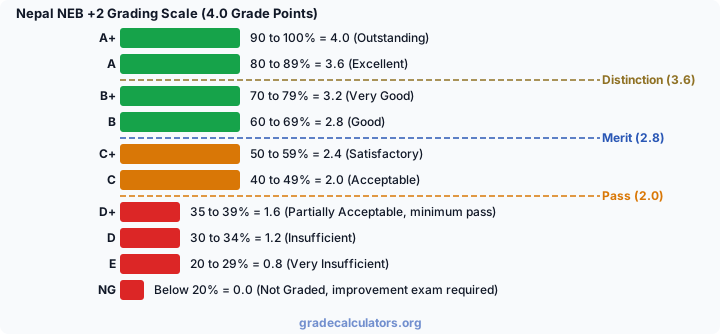
Two features of the NEB scale are worth noting. First, the top four grades each span 10 percentage points, making NEB more forgiving in the upper range than many international systems. A student scoring anywhere from 80 to 89% earns the same A (3.6), and anywhere from 70 to 79% earns B+ (3.2). Second, the grades below 40% narrow considerably, with D+, D, E, and NG each covering only 5 to 10 percentage points. This compression at the lower end means small differences in marks near the pass boundary can change the grade significantly.
Grade Classifications in Nepal NEB
NEB +2 results are interpreted using four academic classifications based on the computed GPA. These are informal benchmarks widely used by Nepali universities and employers when assessing Class 11 and 12 performance.
| Classification | GPA Range | Grade Letters | Significance |
|---|---|---|---|
| Distinction | 3.60 to 4.00 | A, A+ | Top academic performance; competitive for scholarship programs and selective university entrance |
| Merit | 2.80 to 3.59 | B, B+ | Strong performance; qualifies for most Nepal university entrance exams and government scholarships |
| Pass | 2.00 to 2.79 | C, C+ | Passing result; eligible for general university admission but may not qualify for competitive programs |
| At Risk | 0.01 to 1.99 | D+, D, E | Below standard; individual subject pass status determines whether a Grade Improvement Exam is required |
| Fail (NG) | 0.00 | NG | Not graded; subject scored below 20%; Grade Improvement Examination required to clear the subject |
The dynamic threshold bar in the calculator above displays your GPA position across these zones in real time. Your computed GPA is shown as a circle on the bar, so you can see at a glance which zone you occupy and how far you are from the next threshold.
NEB vs. TU (University) Grading in Nepal
Nepal operates two distinct grading frameworks for the pre-university and university levels. Understanding the difference matters both for tracking your own academic progress and for translating NEB +2 results to university admission applications.
| Feature | NEB +2 (Grade 11, 12) | TU / KU / PU (University) |
|---|---|---|
| Grade point scale | 0.0 to 4.0 | 0.0 to 4.0 |
| Number of letter grades | 10 (A+, A, B+, B, C+, C, D+, D, E, NG) | 11 (A, A-, B+, B, B-, C+, C, C-, D+, D, F) |
| Top grade threshold | A+ = 4.0 (90% and above) | A = 4.0 (90% and above) |
| Minimum pass grade | D+ = 1.6 (35% and above) | D = 1.0 (40% and above, varies by university) |
| Percentage conversion | Percentage = GPA x 25 | Percentage = GPA x 25 (TU, KU); GPA x 20 at PU |
| Credit system | 1 credit per subject (standard +2) | 3 to 5 credits per course (semester system) |
| Applied at | NEB Class 11, Class 12, SEE Class 10 | TU, KU, PU, PBU, FWU, MWU bachelor and master programs |
The most practical difference between NEB and university grading is the credit weight. NEB subjects each carry 1 credit, so your GPA is simply the average of your subject grade points. University courses carry 3, 4, or 5 credits each, meaning a high grade in a 5-credit course shifts your CGPA considerably more than the same grade in a 3-credit course. For NEB students planning their university years, the Nepal GPA Calculator hub covers both systems with a mode toggle so you can project your university CGPA before enrollment.
For NEB graduates applying to universities in India, Bangladesh, or internationally, the NEB 4.0 GPA transfers directly to contexts that use a 4.0 scale. The India GPA Calculator and Bangladesh GPA Calculator use different percentage thresholds for their letter grades, but the numeric 4.0 axis is the same reference point across all three systems.
Related Calculators
Last verified: May 2026. NEB grading policy sourced from the National Examinations Board Nepal. Grading rules are subject to annual revision; confirm current cutoffs with your institution before submission.