GPA to CGPA Calculator
US letter grade reference (4.0 scale) and Indian CGPA bands
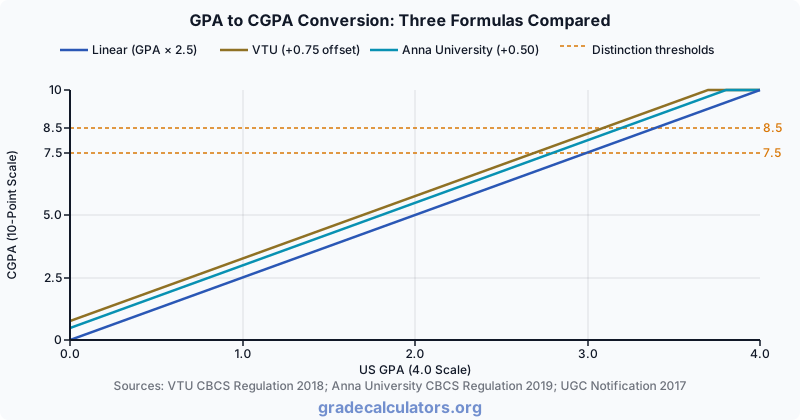
Indian standing bands follow the UGC notification 2017: Outstanding (8.5+), First with Distinction (7.5 to 8.49), First Division (6.0 to 7.49), Second Division (4.0 to 5.99), Fail (below 4.0) on the 10-point scale. Individual universities adjust these by 0.25 to 0.5 of a CGPA point; verify with your registrar before relying on a band label for transfer credit or scholarship decisions.
How to Calculate CGPA from GPA
Calculating CGPA from a GPA is a scale change: US universities report a Grade Point Average on a 4.0 scale, while Indian universities report a Cumulative Grade Point Average on a 10-point scale at most institutions under UGC and AICTE. The simplest conversion is the linear method: divide your GPA by the maximum value of your scale, then multiply by 10. For the most common case (US 4.0 to Indian 10-point), the formula simplifies to CGPA = GPA x 2.5. The GPA to CGPA calculator above runs the conversion live; you can also pick a per-institution formula (VTU, Anna University, SPPU, MAKAUT, AICTE) so the result matches the figure your registrar applies on the transcript.
- GPA = your Grade Point Average on the 4.0 scale (US default)
- 4 = source scale maximum (US default; use 4.33 for Canadian universities, 5.0 for US weighted high school)
- 10 = target scale maximum (Indian university default; use 7 or 5 for other systems)
How to Convert GPA to CGPA Step by Step
- Confirm the source scale. Almost every US college reports GPA on a 4.0 scale. Canadian universities (McGill, Toronto, UBC, McMaster) use 4.33 where A+ counts as 4.33. US high school transcripts with honours and AP courses can report a weighted 5.0 GPA.
- Pick the CGPA target. Pick 10-point for almost every Indian university (CBSE, UGC, VTU, Anna University, SPPU, MAKAUT, AKTU, GTU). Pick 7-point for a handful of autonomous institutes. Pick 5-point for Nigerian and some South Asian universities.
- Apply the formula. Linear: CGPA = (GPA / source_max) x target_max. A 3.0 GPA on the 4.0 scale gives (3.0 / 4) x 10 = 7.5 CGPA on the 10-point scale.
- Pick the institution variant if it applies. VTU adds 0.75 to the linear result. Anna University, SPPU, MAKAUT, and AICTE all use the linear formula with no offset. Pick the formula your university publishes from the dropdown above.
- Read the standing band and percentage equivalent. The calculator output above includes the Indian standing band (Outstanding / First with Distinction / First Division / Second Division / Fail) and the percentage equivalent (via CBSE x9.5) for application forms that require both figures.
GPA to CGPA Conversion Table
The reference table below covers every common 4.0 GPA value (2.5, 2.8, 3.0, 3.2, 3.3, 3.5, 3.7, 3.88, 4.0) and shows the linear 10-point CGPA, the VTU CGPA, the percentage equivalent, the US letter grade, and the Indian standing band. Anna University publishes its own CGPA-to-percentage formula (Percentage = CGPA x 10) but no separate GPA-scale offset, so its CGPA equivalent matches the Linear CGPA column exactly. The 3 gpa to cgpa, 3.3 gpa to cgpa, and 3.2 gpa to cgpa rows are the three most-searched values in the cluster data.
| GPA | Linear CGPA GPA x 2.5 (Anna, SPPU, MAKAUT) | VTU CGPA +0.75 offset | Percentage CGPA x 9.5 | Letter | Indian standing |
|---|---|---|---|---|---|
| 4.0 | 10.00 | 10.00 | 95.0% | A | Outstanding |
| 3.9 | 9.75 | 10.00 | 92.6% | A | Outstanding |
| 3.88 | 9.70 | 10.00 | 92.2% | A | Outstanding |
| 3.7 | 9.25 | 10.00 | 87.9% | A- | Outstanding |
| 3.5 | 8.75 | 9.50 | 83.1% | A- | Outstanding |
| 3.3 | 8.25 | 9.00 | 78.4% | B+ | First with Distinction |
| 3.2 | 8.00 | 8.75 | 76.0% | B+ | First with Distinction |
| 3.0 | 7.50 | 8.25 | 71.3% | B+ | First with Distinction |
| 2.8 | 7.00 | 7.75 | 66.5% | B | First Division |
| 2.5 | 6.25 | 7.00 | 59.4% | B- | First Division |
| 2.2 | 5.50 | 6.25 | 52.3% | C+ | Second Division |
| 2.0 | 5.00 | 5.75 | 47.5% | C | Second Division |
| 1.5 | 3.75 | 4.50 | 35.6% | D | Fail |
3.0, 3.2, 3.3, 3.5 GPA to CGPA: The Most-Searched Values
For the most-searched US 4.0 GPA values: 3 gpa to cgpa is 7.5 on the linear method (also Anna University), 8.25 at VTU. 3.2 gpa to cgpa is 8.0 linear/Anna, 8.75 at VTU. 3.3 gpa to cgpa is 8.25 linear/Anna, 9.0 at VTU. 3.5 gpa to cgpa is 8.75 linear/Anna, 9.5 at VTU. 3.88 gpa to cgpa is 9.7 linear/Anna, which is capped at 10.0 under the VTU formula because the offset pushes the value above the scale maximum. The GPA to CGPA calculator above returns the exact value for any GPA instantly under every formula option.
CGPA Classification and Standing Bands
Indian universities classify academic performance into standing bands based on CGPA. The UGC notification 2017 defines five bands on the 10-point scale. Individual institutions adjust the cutoffs slightly; the table below shows the UGC baseline alongside the most common institutional variants so you know which band a converted CGPA falls into.
| Standing | UGC (10-pt) 2017 baseline | VTU CBCS 2018 | Anna Univ. CBCS 2019 | US GPA equiv. linear 4.0 | Percentage CGPA x 9.5 |
|---|---|---|---|---|---|
| Outstanding (O) | 8.50 to 10.0 | 9.0 to 10.0 | 9.0 to 10.0 | 3.40 to 4.0 | 80.8% to 95% |
| First with Distinction (A+) | 7.50 to 8.49 | 8.0 to 8.99 | 8.0 to 8.99 | 3.00 to 3.39 | 71.3% to 80.7% |
| First Division (A) | 6.00 to 7.49 | 6.5 to 7.99 | 6.5 to 7.99 | 2.40 to 2.99 | 57.0% to 71.2% |
| Second Division (B) | 4.00 to 5.99 | 4.5 to 6.49 | 4.5 to 6.49 | 1.60 to 2.39 | 38.0% to 56.9% |
| Fail (F) | Below 4.0 | Below 4.5 | Below 4.5 | Below 1.60 | Below 38.0% |
The Outstanding band matters most for scholarship applications. Many Indian central government scholarships require CGPA 8.5 or above (the UGC baseline), but some IITs and NITs set their internal outstanding cutoff at 9.0 or higher. A converted CGPA that reads 8.4 under the linear formula may still qualify as First with Distinction (A+) at most universities, even if it misses the Outstanding band by 0.1. Always check the specific scholarship or admission notice for the exact cutoff.
SGPA to CGPA: Calculating Cumulative CGPA from Semester GPAs
SGPA (Semester Grade Point Average) is the per-semester figure; CGPA is the cumulative figure across all semesters. If you have SGPA values for each completed semester and want to find the overall CGPA, you weight each SGPA by the number of credits in that semester.
- SGPA = semester grade point average for each semester
- Credits = total credits registered in that semester
- Sum is taken across ALL completed semesters
Most Indian universities compute CGPA this way automatically; the SGPA-to-CGPA calculation is what your registrar runs after each semester's results. For a dedicated SGPA calculator with per-course grade entry, use the SGPA calculator. For computing CGPA directly from individual course grades, use the CGPA calculator.
Convert GPA to CGPA: Which Formula to Use
The GPA to CGPA conversion has more institutional variation on the Indian side than the US side. US universities all use the same 4.0 scale (with a small number reporting on 4.33 for A+). Indian universities all report on a 10-point CGPA but apply different formulas when issuing the percentage equivalent on the transcript. The linear formula CGPA = GPA x 2.5 matches the CBSE board, AICTE technical institutes, SPPU, MAKAUT, AKTU, GTU, and Anna University. VTU adds a 0.75 offset that derives from its Choice-Based Credit System handbook percentage formula. Pick the formula your target institution publishes; the calculator above defaults to linear and exposes per-institution variants in the dropdown.
VTU GPA to CGPA
VTU (Visvesvaraya Technological University) reports CGPA on the 10-point scale under its Choice-Based Credit System (CBCS). To convert a US 4.0 GPA to a VTU CGPA, apply CGPA = (GPA x 2.5) + 0.75. A 3.0 US GPA gives 8.25 VTU CGPA. A 3.5 US GPA gives 9.5 VTU CGPA. The 0.75 offset comes from VTU's published percentage formula Percentage = (CGPA - 0.75) x 10; the offset shifts the percentage band to align with VTU's historical First Class cutoff at 60 percent (which under the linear formula would correspond to CGPA 6.0 but at VTU corresponds to CGPA 6.75). For percentage conversion alone, use the CGPA to percentage calculator.
Anna University GPA to CGPA
Anna University reports SGPA per semester and CGPA across semesters on the 10-point scale under its CBCS regulation 2019. To convert a US 4.0 GPA to an Anna University CGPA equivalent, apply the linear formula CGPA = GPA x 2.5, same as the general conversion. A 3.0 US GPA gives 7.5 Anna CGPA. A 3.5 US GPA gives 8.75 Anna CGPA. Anna University's own published formula, Percentage = CGPA x 10 (Clause 16 of its academic regulations, unchanged across Regulation 2013, 2017, and 2021), carries no offset, so its GPA-scale conversion matches the linear formula rather than the discounted VTU/UGC variant. For lateral entry and credit-transfer paperwork, Anna University's transcript office accepts the published formula above.
SPPU, MAKAUT, AICTE GPA to CGPA
SPPU (Savitribai Phule Pune University), MAKAUT (Maulana Abul Kalam Azad University of Technology, Bengal), and AICTE-affiliated institutes use the linear formula CGPA = GPA x 2.5 for converting a US 4.0 GPA to a 10-point CGPA. A 3.0 US GPA gives 7.5 CGPA at all three. A 3.5 US GPA gives 8.75 CGPA. SPPU's percentage formula is the standard CBSE x9.5 multiplier; MAKAUT publishes Percentage = (CGPA - 0.75) x 10 which mirrors VTU but is applied to the percentage path rather than the GPA-to-CGPA path. AICTE does not publish its own scale and defers to the affiliated university's formula in most cases.
GPA and CGPA: What They Mean
GPA stands for Grade Point Average; in the United States it is reported on a 4.0 scale where A = 4.0 and F = 0. CGPA stands for Cumulative Grade Point Average; in India it is reported on a 10-point scale where O (Outstanding) = 10 and F (Fail) = 0. Both metrics measure the same underlying performance, just on different number lines. The core calculation, GPA = Sum(Grade Points x Credit Hours) / Sum(Credit Hours), is identical in both systems; only the maximum grade-point value differs.
In US usage, GPA can refer to either a single-semester GPA or the cumulative GPA across all semesters, depending on context. In Indian usage, CGPA almost always means the cumulative figure, while SGPA refers to the single-semester figure. When a US graduate application asks for your GPA, it wants the cumulative GPA; the equivalent Indian term is CGPA. The GPA calculator covers the US 4.0 computation from per-course grades. For per-semester computation in the Indian system, see the SGPA calculator. For computing CGPA from individual course grades, use the CGPA calculator. For the inverse direction (CGPA back to GPA), use the CGPA to GPA converter. For multi-scale conversions across systems, the GPA converter handles 9 different source scales.
GPA from CGPA: The Reverse Direction
To find GPA from CGPA, apply the inverse formula GPA = (CGPA / 10) x 4 = CGPA / 2.5. A 7.5 CGPA gives 3.0 GPA. An 8.5 CGPA gives 3.4 GPA. A 9.0 CGPA gives 3.6 GPA. The calculator above supports the reverse direction via the direction toggle; switching to CGPA to GPA flips the input and output labels and applies the inverse formula automatically. For a more detailed CGPA-to-GPA tool with WES band-mapping and 7-point and 5-point source CGPA support, use the CGPA to GPA converter.
GPA to CGPA on the 4.33 Canadian Scale
Canadian universities (McGill, Toronto, UBC, McMaster, Queen's, Waterloo, Western, SFU) use a 4.33 GPA scale where A+ counts as 4.33 and A counts as 4.0. To convert a 4.33 Canadian GPA to a 10-point Indian CGPA, apply the linear formula with the new source maximum: CGPA = (GPA / 4.33) x 10. A 4.0 GPA on the 4.33 scale gives (4.0 / 4.33) x 10 = 9.24 CGPA. The calculator above supports the 4.33 source via the scale toggle. For Canadian university-specific GPA calculators, see the Canada GPA calculator hub; for the 4.33 to 4.0 scale conversion, the figure is GPA_4.0 = GPA_4.33 x (4 / 4.33) = GPA_4.33 x 0.924.
Using the GPA to CGPA Calculator for Indian University Applications
The GPA to CGPA calculator output is the figure students use when applying from a US or Canadian university to an Indian graduate programme, when transferring credits to an Indian university lateral entry programme, or when converting an exchange-semester US GPA into the Indian transcript format. Most Indian universities accept the linear conversion for international transcripts; VTU prefers its published offset formula even for incoming international students. Verify with the international admissions office before submitting paperwork; an unexpected 0.75 CGPA shift between the linear and VTU formulas can change the standing band on the transcript and affect scholarship eligibility.
The CGPA to GPA calculator (reverse direction) is more often used in the opposite direction: Indian students applying to US graduate programmes need their 10-point CGPA expressed as a 4.0 GPA. The official figure for US graduate admissions comes from a WES or ECE credential evaluation, which evaluates each course grade against the published India grade scale and recomputes the 4.0 GPA from per-course US letter-grade equivalents. The linear conversion from this page is a planning estimate that typically falls within 0.1 of the WES figure for transcripts with even grade distribution.
The gpa to cgpa calculator applies the linear formula CGPA = (GPA / source_max) x target_max for the default conversion and published per-institution formulas for VTU (CBCS handbook regulation 2018), Anna University (CBCS regulation 2019), SPPU, MAKAUT, and AICTE. The reverse direction (CGPA to GPA) uses the inverse linear formula. Both methods are planning estimates for international academic use. For US graduate admissions from an Indian transcript, only the official WES, ECE, or other NACES-member credential evaluation is binding; order the report 6 to 8 weeks before deadlines. Sources: UGC India notification 2017 (10-point CGPA standing bands), AICTE India approval handbook, WES India grade scale, AACRAO international transcript guidelines, VTU CBCS handbook, Anna University regulation 2019, and individual university registrar pages for the 4.33 Canadian scale. Last verified: May 2026.